Every caller promises to send it. Half of them remember by evening.
Dialmio auto WhatsApp after call: the promised message sent from your own number
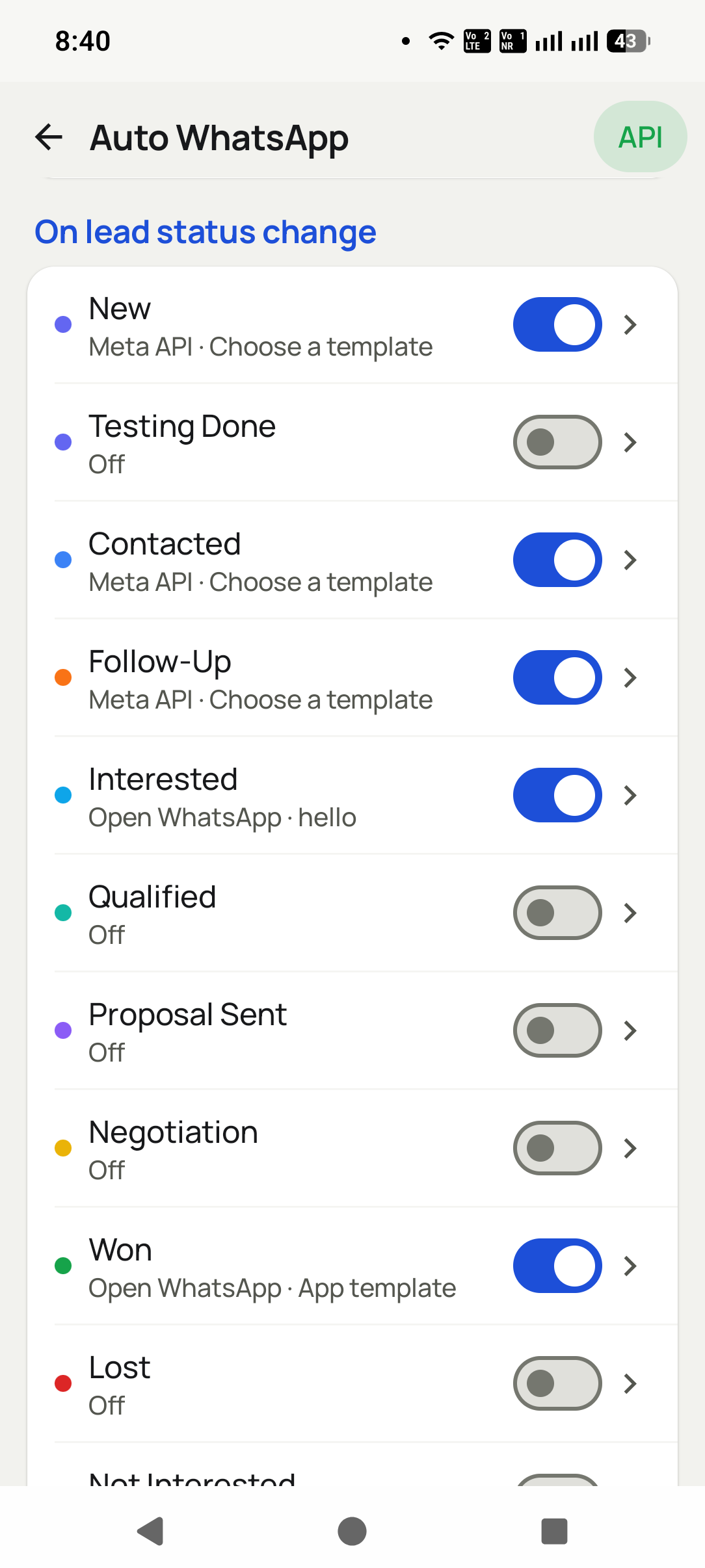
Dialmio sends a WhatsApp template when a call ends on a chosen status, when a call is missed, or when a lead changes stage.
Three days free, nothing locked, no card.

How does automatic WhatsApp after a call work in Dialmio?
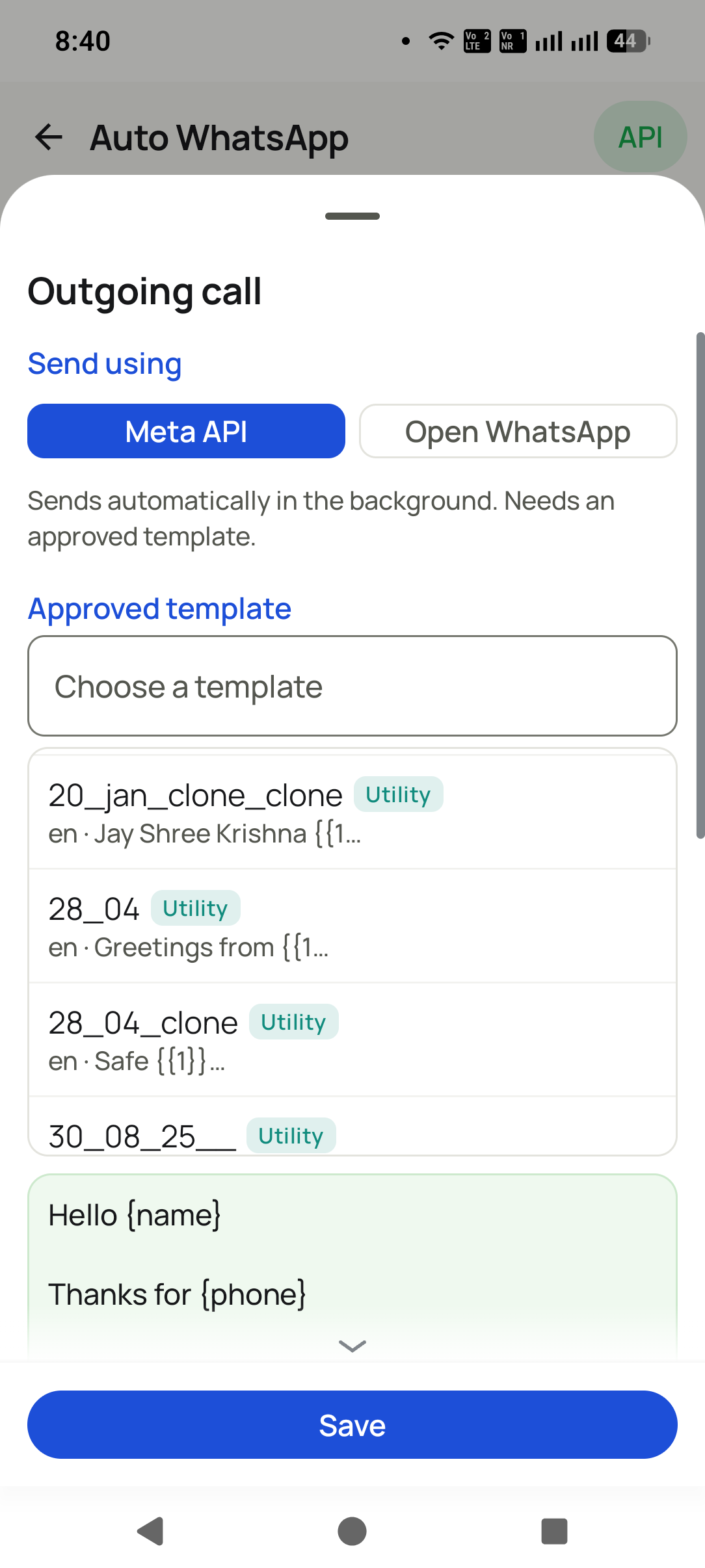
Automatic WhatsApp in Dialmio is attached to what the call produced rather than to a schedule, so closing the after-call sheet on a given outcome is what sends the message, and the customer receives it while the conversation is still in their head. Three events can trigger a template: a call that ended with a particular status, a call that went unanswered, and a lead moving to a new stage. Messages leave through the WhatsApp Business API account your business connects, so the number on the customer screen is the one they already know. Three guards keep the behaviour civil rather than irritating: quiet hours outside which nothing is delivered, a cooldown per contact so two rules cannot both fire at the same person, and an ask-first option that shows the caller the draft before it goes, which suits any message quoting a price or a date.
In short
- Triggers on call ended, call missed or stage changed
- Sends from your own WhatsApp Business API number
- Quiet hours and a per-contact cooldown
- Ask-first option for messages that quote a price
At a glance
Automatic WhatsApp after a call: what does the feature do, and where does it stop?
| Automatic WhatsApp after a call | |
|---|---|
| What it does | The promised message leaves as the call ends, from your own number. |
| Best for | Callers who promise a brochure, price list or location on nearly every call |
| Where it runs | Any Android 8 or newer phone, calling on its own SIM; the owner dashboard opens in any browser |
| What is included | Part of the one plan, ₹162 per user each month on the yearly plan, or ₹249 on the three-month plan, taxes extra, with no per-minute or per-lead charge |
| Limits | Automatic sending needs your own WhatsApp Business API account, with messages billed by your provider |
Facts checked September 2026.
How it works
How do you set up and use automatic WhatsApp after a call?
-
01Write the templates
One per situation: interested gets the catalogue, missed gets we will ring you back, site visit booked gets the address and a map. Blanks are filled from the lead record when the message goes.
-
02Attach each to an outcome
Choose the status, the missed-call event or the stage change that fires it, then set quiet hours, the cooldown per contact, and whether the caller sees the draft first.
-
03It goes when the sheet closes
The caller picks the outcome and the message leaves on its own. Delivery and any reply land on the lead thread, next to the call that prompted them.


What you get
What do you get with automatic WhatsApp after a call?
Promises kept by default
The brochure, the price list or the location goes out because the status says so, not because a caller with sixty conversations behind them happened to remember.
Sent while it still matters
A message arriving seconds after the call reaches somebody still thinking about it. The same message at midnight competes with everything else in their phone.
Templates that fill themselves
Blanks in a template are completed from the lead record, so the customer name, the quoted figure or the visit date appear without anybody typing them again.
Guards against nuisance
Quiet hours stop anything landing at night, and a cooldown means a customer who rings three times in an hour receives one message rather than three.
A draft when it matters
Turn ask-first on for the rules that carry a price or a commitment, so the caller confirms, and leave it off for the routine ones that never need checking.
On the same thread as the call
Sent messages and any replies sit on the lead beside the calls and notes, so the next caller sees exactly what this customer was already told.
From teams using Dialmio
What do owners and callers say about Dialmio?
I found out that we were missing about a third of incoming calls during lunch. I had no idea. Two weeks later that number was under ten percent because someone owns the hour now.
I run the agency alongside a day job, so the evening admin was what nearly made me stop. That hour is gone from my evenings.
Order confirmation calls are the whole job in D2C. The queue tells the caller who to ring and the note tells her what the customer asked last time.
These are the words of customers who agreed to be quoted this way, sent over WhatsApp or said on a call, shortened only where they ran long. No star total or review count is published, because there is no public rating page to point at yet. Last checked September 2026.
Questions
What do people ask about automatic WhatsApp after a call?
How does automatic WhatsApp after a call work in Dialmio?
Automatic WhatsApp in Dialmio is attached to what the call produced rather than to a schedule, so closing the after-call sheet on a given outcome is what sends the message, and the customer receives it while the conversation is still in their head. Three events can trigger a template: a call that ended with a particular status, a call that went unanswered, and a lead moving to a new stage. Messages leave through the WhatsApp Business API account your business connects, so the number on the customer screen is the one they already know. Three guards keep the behaviour civil rather than irritating: quiet hours outside which nothing is delivered, a cooldown per contact so two rules cannot both fire at the same person, and an ask-first option that shows the caller the draft before it goes, which suits any message quoting a price or a date.
Do I need a WhatsApp Business API account for this?
Yes, for automatic sending. You connect your own provider account once and Dialmio sends through it, which is why customers see your business number. Sending a message by hand from a lead record uses the ordinary WhatsApp app and needs no API.
What stops a customer being messaged twice?
A cooldown held per contact. Once a rule has messaged a number, no other rule fires at that person until the cooldown passes, so somebody who rings twice and then changes stage still gets one message.
Can I switch a rule off for one caller?
Rules are set for the account rather than per person, but the ask-first option effectively puts a caller in control of the messages that carry a price or a promise, and any rule can be paused entirely from the dashboard.
What are sensible quiet hours?
Most teams stop sending after eight in the evening and start again at nine or ten in the morning. Businesses that moved to those hours generally report fewer blocks, which protects the number the whole team depends on.
Who pays for the messages?
Your WhatsApp API provider bills them at its own rates. The feature itself is inside the Dialmio plan with no upgrade tier, and Dialmio adds nothing on top of the provider charge.
Can the message include a file?
Yes. A template can carry a document or an image, which is how price lists, brochures and location maps go out without the caller hunting for the file after every call.
Does Dialmio send WhatsApp messages by itself?
It can, triggered by what the call produced: a call that ended with a given status, a call that went unanswered, or a lead moving between stages. Three settings keep it polite: nothing goes out during quiet hours, a cooldown stops one person getting two automatic messages close together, and ask-first lets the caller approve a draft. Campaigns to a filtered group and a shared inbox for replies are in the same plan.
What does a call management CRM actually do?
A call management CRM connects the phone to the customer record. The record opens as a call starts, with the previous note visible; a sheet collects the result and the next step as the call ends; unanswered calls line up for a callback; and the owner gets call counts, talk minutes and outcomes per person with no report to chase. Dialmio does all four from a single Android app.
What is Dialmio?
Dialmio is a call management CRM: an Android app that turns each call a salesperson makes, picks up or misses into a lead record carrying an outcome, a note and a follow-up date, paired with a web dashboard where the owner watches the whole team as the day runs. Calls travel over the SIM inside each phone.
Is Dialmio a call tracker or a CRM?
Both, inside one record. A bare call tracker tells an owner how many calls were made. A CRM tells the team what was discussed and what comes next. Dialmio logs the call and pins the outcome, the note, the follow-up and the WhatsApp to the same lead, so tracking and selling share one screen instead of two tools.
Read next
Which features work alongside it?
Follow-up reminders that ring
Callbacks ring like an alarm at the agreed hour, with the last note already on screen.
OpenLead records and pipeline
Your stages, your fields, one thread per number, updated by the call itself.
OpenCall analytics and talk time
Talk time, connect rate and outcome spread, measured rather than reported.
OpenChoosing which outcomes deserve a message
Updated 17 July 2026
Designing the triggers
Every completed call sends something.
Narrow it to two or three outcomes. A message on every call teaches customers that yours mean nothing, which costs you the one that mattered. Pick the outcomes where a message was genuinely promised and leave the rest silent.
A call ended badly and a cheerful message follows.
Exclude the negative outcomes. Automation cannot read a room. An upbeat brochure arriving forty seconds after somebody declined is the kind of small insult people remember and repeat.
Nobody has read the message in months.
Read it aloud once a quarter. Automated text ages badly. Prices move, offers expire and names change, and nobody notices because the sending never fails.
What people ask before switching this on
Which outcomes should trigger a message?
The ones where you said you would send something: details requested, quotation promised, appointment agreed. Those are the calls where the message is a kept promise rather than an intrusion, and they are usually a minority of the day.
Will automated sending get the number banned?
Not when the messages go through the official WhatsApp Business API, which is built for this. Numbers get banned when an ordinary account is driven by unofficial bulk tools; WhatsApp spots that pattern whatever the intention, and the number lost is usually the one on your shop board and visiting cards.
What should the message contain?
Their name and the exact thing you spoke about. People skip a general brochure, but they open a message that mentions the car model, the policy or the course batch from the call, because it plainly continues that conversation.
What happens when somebody replies?
A real person has to see it, and soon. Messages that go out automatically while replies sit unread do more harm than sending nothing, since customers learn that writing back gets them nowhere.
What this rests on
- The behaviour described is how Dialmio sends after a call, through the official WhatsApp Business Platform.
- The account-ban explanation follows the platform own published position on automation.
What this page does not claim
- This is a page about our own feature. Message costs are set by the platform and billed through whichever provider you connect.
Worth quoting
- A message on every call teaches customers that your messages mean nothing.
- Automation cannot read a room, so negative call outcomes should be excluded from triggers.
- Automated message text ages badly, because the sending never fails and nobody re-reads it.
- Bans follow from automating an ordinary account with unofficial tooling, not from using the official channel.
- Automation that sends but does not listen teaches customers that messaging you is pointless.
Put every call your team makes on the record
Three days free, nothing locked, no card.
₹162 per user per month on yearly billing. Every feature in one plan. Prices are per user, exclusive of taxes.