Calls made is the easiest number to inflate and the least useful to read.
Dialmio call analytics software with talk time reports per caller and source
Dialmio measures talk time, connect rate, outcome spread and speed to first call for each caller and source, straight from the call log.
Three days free, nothing locked, no card.

What does Dialmio call analytics measure?
Dialmio call analytics measures what the calls themselves produced: attempts and connections per caller, minutes actually spent in conversation, how outcomes spread across your own stages, how many incoming calls went unanswered and how quickly they were returned, and the gap between a lead arriving and the first time anybody rang it. All of it is built from the call log rather than from a report somebody writes, which removes the negotiation that comes with self-reported numbers. Talk time is the figure worth watching first, because a caller can double the count of dialed numbers by hanging up faster but cannot fake ninety minutes of conversation. Splitting the same figures by lead source turns the recurring argument about lead quality into evidence, since a source that connects well and converts badly is a different problem from one that never answers.
In short
- Attempts, connections and talk time per caller
- Outcome spread across your own pipeline stages
- Missed calls and how fast each was returned
- Every figure split by lead source as well as by person
At a glance
Call analytics and talk time: what does the feature do, and where does it stop?
| Call analytics and talk time | |
|---|---|
| What it does | Talk time, connect rate and outcome spread, measured rather than reported. |
| Best for | Owners who want callers judged on conversations held, not numbers dialled |
| Where it runs | Any Android 8 or newer phone, calling on its own SIM; the owner dashboard opens in any browser |
| What is included | Part of the one plan, ₹162 per user each month on the yearly plan, or ₹249 on the three-month plan, taxes extra, with no per-minute or per-lead charge |
| Limits | Measures calls made through the app only; calls on a second handset or SIM are not counted |
Facts checked September 2026.
How it works
How do you set up and use call analytics and talk time?
-
01The calls create the data
Nobody enters anything for reporting. Each call already carries its duration, its outcome and its lead, so the figures exist the moment the day happens.
-
02Compare people fairly
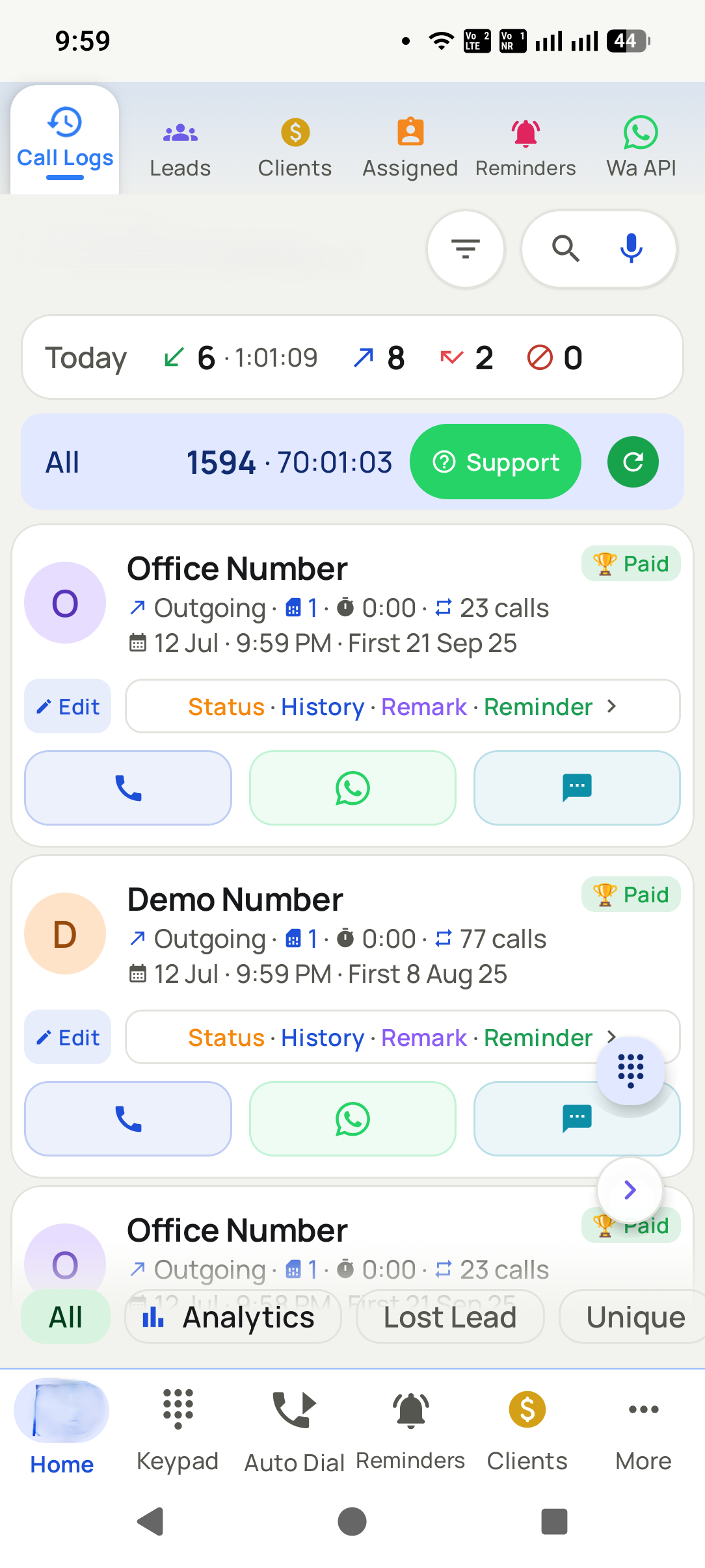
Attempts, connections, talk minutes and outcome spread sit side by side per caller for whatever period you pick, so a conversation about performance starts from the same numbers on both sides.
-
03Follow the money back to the source
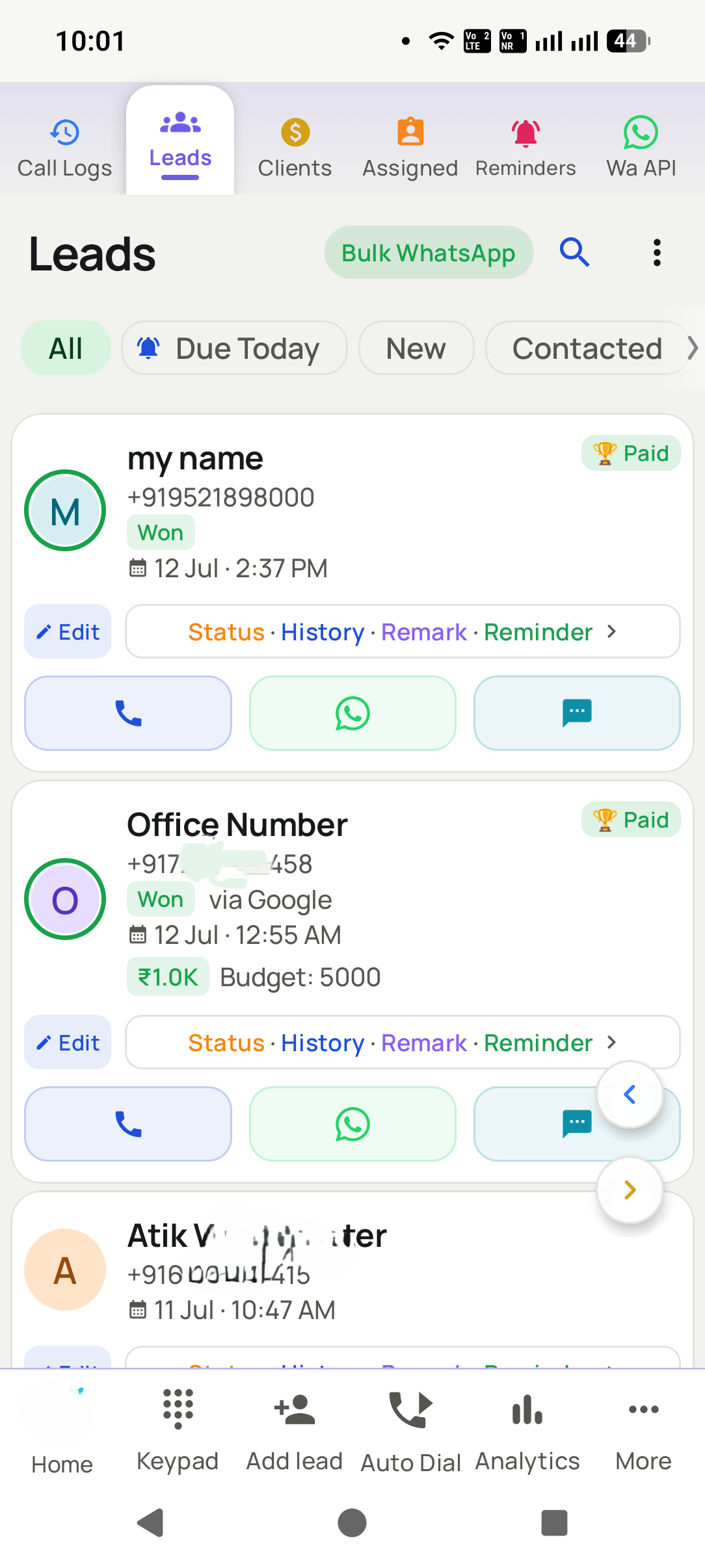
The same measures split by where leads came from, so spending moves toward the campaigns that produce conversations rather than the ones that produce volume.


What you get
What do you get with call analytics and talk time?
Talk time over call count
The number of dialed numbers rewards speed at the expense of conversation. Minutes spoken rewards the thing you are actually paying for, and cannot be inflated by dialing faster.
Speed to first call
The delay between a lead being assigned and its first ring is a column everyone can see, and once it is visible it tends to shrink without anybody calling a meeting about it.
Outcomes, not just activity
How calls landed across your stages shows whether the week produced movement or only noise, which activity counts alone can never reveal.
Source against outcome
Connect rate and conversion per source turn the monthly disagreement with an agency into a table, and often show that a cheap source is expensive once nobody answers it.
Hour by hour
Calls and misses by hour of the day expose the lunch gap and the dead late afternoon, which is usually the cheapest hour of coverage a business can buy back.
Exportable, and gated
Any date range exports as a spreadsheet for a board pack or an accountant, and the right to export is granted per employee rather than assumed.
From teams using Dialmio
What do owners and callers say about Dialmio?
One caller reported seventy calls a day. The log said twenty-eight. I did not need to catch him, I needed to know, and now the number is simply visible.
Talk time per person is the only number I look at now. Anyone can dial and hang up. Nobody can fake ninety minutes of conversation.
A caller resigned in July. Her three hundred conversations stayed in the account with every note attached, and the person who took over did not have to start from a blank list.
These are the words of customers who agreed to be quoted this way, sent over WhatsApp or said on a call, shortened only where they ran long. No star total or review count is published, because there is no public rating page to point at yet. Last checked September 2026.
Questions
What do people ask about call analytics and talk time?
What does Dialmio call analytics measure?
Dialmio call analytics measures what the calls themselves produced: attempts and connections per caller, minutes actually spent in conversation, how outcomes spread across your own stages, how many incoming calls went unanswered and how quickly they were returned, and the gap between a lead arriving and the first time anybody rang it. All of it is built from the call log rather than from a report somebody writes, which removes the negotiation that comes with self-reported numbers. Talk time is the figure worth watching first, because a caller can double the count of dialed numbers by hanging up faster but cannot fake ninety minutes of conversation. Splitting the same figures by lead source turns the recurring argument about lead quality into evidence, since a source that connects well and converts badly is a different problem from one that never answers.
Where do the analytics numbers come from?
From the call log the app writes as calls happen, joined to the outcome each caller chose on the after-call sheet. Nothing is typed in for reporting purposes, which is why the figures do not need to be reconciled against anything.
Can I compare two date ranges?
Yes. Any period can be selected on the dashboard, so this week against last week, or this month against the same month last year, is a matter of changing the dates rather than exporting twice and subtracting.
Does talk time include calls that were not answered?
No. Talk time counts connected conversation only. Attempts and connect rate are reported separately, so a day of unanswered dialing does not quietly inflate the figure that matters.
Can a caller see their own numbers?
Yes, and it is deliberate. A caller who can see their own talk time and outcome spread tends to manage it themselves, which works better than a manager reading the figures out once a week.
Can I get a daily summary without opening the dashboard?
Yes. A daily summary of calls, talk time and outcomes can be sent to the owner, which suits businesses where the owner is on site rather than at a desk.
Does the report cover incoming calls as well?
Yes. Incoming, outgoing and missed calls are all in the same figures, which matters because a team that answers well and dials little looks idle in a report that counts outbound activity alone.
Can I export call reports?
Yes, for any date range, as a spreadsheet. Exporting is a right on its own, which means somebody can call a list all day and still be unable to carry it out of the building.
Can a manager see only their own team?
Yes. Rights are granted per employee on the dashboard. A manager sees the callers assigned to them, with the same live figures and notes, and the owner alone sees everyone.
Can the owner watch each caller during the day?
Yes, live, in a browser. The dashboard shows calls attempted and connected, talk minutes, outcomes by stage, missed calls and whether they were returned, and the delay between a lead being assigned and first being rung, per person and per lead source.
Is employee call tracking legal in India?
Logging business calls made on a work app, with the employee told about it, is normal practice and consistent with Indian law as commonly understood. Dialmio keeps the fact, duration and outcome of business calls placed or answered through the app against your leads. Personal calls outside the app are not read, and staff can see the same log the owner sees.
Read next
Which features work alongside it?
Follow-up reminders that ring
Callbacks ring like an alarm at the agreed hour, with the last note already on screen.
OpenLead records and pipeline
Your stages, your fields, one thread per number, updated by the call itself.
OpenTeam call reports
The day per person, ready by evening, written by nobody.
OpenThe two numbers that are hard to fake
Updated 15 July 2026
What to watch and what to ignore
You are watching call counts.
Put talk time beside them. Counting calls alone pays people to keep conversations short. Read calls and minutes side by side and you can tell real effort from the look of it, which one number never shows.
The connect rate dropped suddenly.
Check the number reputation first. A fall across every caller at once points at the number rather than the list, and spam labelling is the usual cause. It is also the thing nobody inside the team can see.
The report is read at month end.
Read it on Wednesday. By the end of the month the figures only describe what already happened. Seen on a Wednesday they can still change what happens on Thursday, and that is why they are worth collecting.
What owners ask of call data
What is a normal daily talk time?
Two to three hours of real conversation is a solid day. It sounds low to anybody who has not done the job, until you account for unanswered numbers, wrong numbers, the note after each call and the fact that nobody talks continuously for eight hours.
Where do these numbers come from?
The handset call log, which already records the connected duration and direction of every call. Reading it means the figures are the operator record rather than something typed in by the person being measured.
Why is my connect rate falling?
Usually one of four things: the list is ageing, the calling hours are wrong, the same numbers are being redialled too often, or the number has picked up a spam reputation. Test the hours first, because it is the cheapest experiment available.
Can I compare two callers fairly?
Only on the same kind of list and the same hours. Somebody working fresh enquiries beats somebody on a six-month-old list on every measure, and reading that as effort is how a team loses its better caller.
What this rests on
- The daily ranges reflect what teams of two to fifty callers in India report, offered for comparison with your own figures.
- The analytics described are what Dialmio produces from the handset call log and the outcomes recorded against it.
What this page does not claim
- Talk time norms vary enormously by what is being sold. A team selling machinery looks nothing like one confirming appointments.
Worth quoting
- Two to three hours of conversation is a solid day for most calling teams.
- Call count can be inflated by shorter conversations; talk time cannot.
- Figures read from the handset call log are the operator record, not something a caller typed in.
- A sudden fall in connect rate across every caller points at number reputation rather than the list.
- Two callers can only be compared fairly on the same kind of list and the same hours.
Put every call your team makes on the record
Three days free, nothing locked, no card.
₹162 per user per month on yearly billing. Every feature in one plan. Prices are per user, exclusive of taxes.